Tuesday, January 31, 2017

More GDP Calculations (1/30 - 1/31)

Expenditure Approach to GDP:

C + Ig + G + Xn
Income Approach to GDP:

(Wages/Compensation/Salary) + Rent + Interest + Profits + Statistical Adjustment

Budget:

Gov't Purchase of Goods/Services + Gov't Transfer Payment - Gov't Tax&Fee Collection
Positive Budget - Deficit
Negative Budget - Surplus

Trade:

Exports - Imports
+ Trade - Surplus
- Trade - Deficit

National Income:

1) Compensation of Employees + Rental Income + Interest Income + Proprietor's Income + Corporate Profits
2) GDP - Indirect Business Taxes - Depreciation - Net Foreign Factor Payment

Disposable Personal Income:

Nat'l Income - Personal Household/Income Taxes + Gov't Transfer Payments


Friday, January 27, 2017

Gross Domestic Product

Gross Domestic Product and

Gross National Product (1/26 - 1/27)

GDP - total value of all product of all final goods and services produced w/in a country's borders in a given year
  • includes all production/income earned w/in U.S. by U.S. and foreign producers
  • excludes productions outside of U.S. earned by Americans
GNP - total value of all goods and services produced by Americans in a given year
  • includes production/income by Americans anywhere in the world
  • excludes production by non-Americans even by the U.S.
GDP Calculations
GDP = C + Ig + G + Xn
C - Personal Consumption Expenditures, 67% of economy
Ig - Gross Private Domestic Investment, 17% of economy
G - Gov't Spending, 18% of economy
Xn - Net Exports (Exports - Imports), -2% o economy

Not Included in a nation's GDP:
1. Intermediate Goods: avoids double or multiple counting
2. Used/Second Hand Goods:thrift store
3. unreported business activities: tips
4. stocks & bonds
5. non market activities: babysitting for family
6. illegal activities: underground stuff and black market
7. Gifts/transfer payments: Scholarships, Social Security, Unemployment

Wednesday, January 25, 2017

Circular Flow Model


Circular Flow Model


Image result for circular flow model


While The Picture is Self - Explanatory,  I Shall Continue to Edit Additional, More Clear Info


Household - a person or group who shares income

Firms/Businesses - organizations that produces goods/services for sale

Thursday, January 19, 2017

Excess and Equilibrium


Excess and Equilibrium (1/19)


Image result for excess demand


  • Equilibrium - point at which the supply curve intersects w/ the demand curve, efficient
  • Excess Demand - occurs when QD > QS
    • results in shortage, consumers cannot get quantities of wanted
  • Price Ceiling - creates a shortage; when gov't places legal limit on how high the price of a product can be
    • Ex - flu shot, rent ctrl
  • Excess Supply - occurs when QS > QD
    • results in surplus; producers have inventories they cannot rid
  • Price Floor - lowest legal price a commodity can be sold at
    • Ex - minimum wage
Image result for excess demand

Friday, January 13, 2017

Notes About Revenue

Notes about Revenue (1/12-1/13)


  • Total Revenue - total amount of $ a firm receives from selling goods & services;
    • TR = P * Q
    • Remember to add a $ to the answer
  • Marginal Revenue - additional income from selling of additional unit of a good
    • Final TR - Initial TR = MR
  • Fixed Cost - a cost that does not changed no matter how much of a good is produced
    • Ex - salary, rent
  • Variable Cost - a cost that rises and falls depending upon how much is produced
  • Marginal Cost/Output
    • new Total Cost - old Total Cost

More Revenue Calculations

Total Fixed Cost - TFC
Total Variable Cost - TVC
Total Cost - TC
Average Fixed Cost - AFC
Average Variable Cost - AVC
Average Total Cost - ATC

TFC + TVC = TC
AFC + AVC = ATC
AFC * Q = TFC
AVC * Q = TVC
TFC / Q = AFC
TVC / Q = AVC
TC / Q ATC


Wednesday, January 11, 2017

Elasticity of Demand

Elasticity of Demand (1/11)

  • A measure in how consumers react to a Δ in price

Elastic Demand

  • demand very sensitive to a Δ in price
  • product not a necessity
  • available substitutes
  • Ex - steak, fur coat, soda
  • E > 1

Inelastic Demand

  • demand not very sensitive to a Δ in price
  • product a necessity
  • few to none substitutes
  • Ex - gas, insulin
  • E < 1

Unitary Elastic

  • impossible in reality
  • E = 1

Calculation for Price Elasticity of Demand (PED)

  • Step 1: Quantity: new Q - old Q / old Q = %Δ in Q
  • Step 2: Price: new P - old P / old P = %Δ in P
  • Step 3: PED: %Δ in Q / %Δ in P = PED

Thursday, January 5, 2017

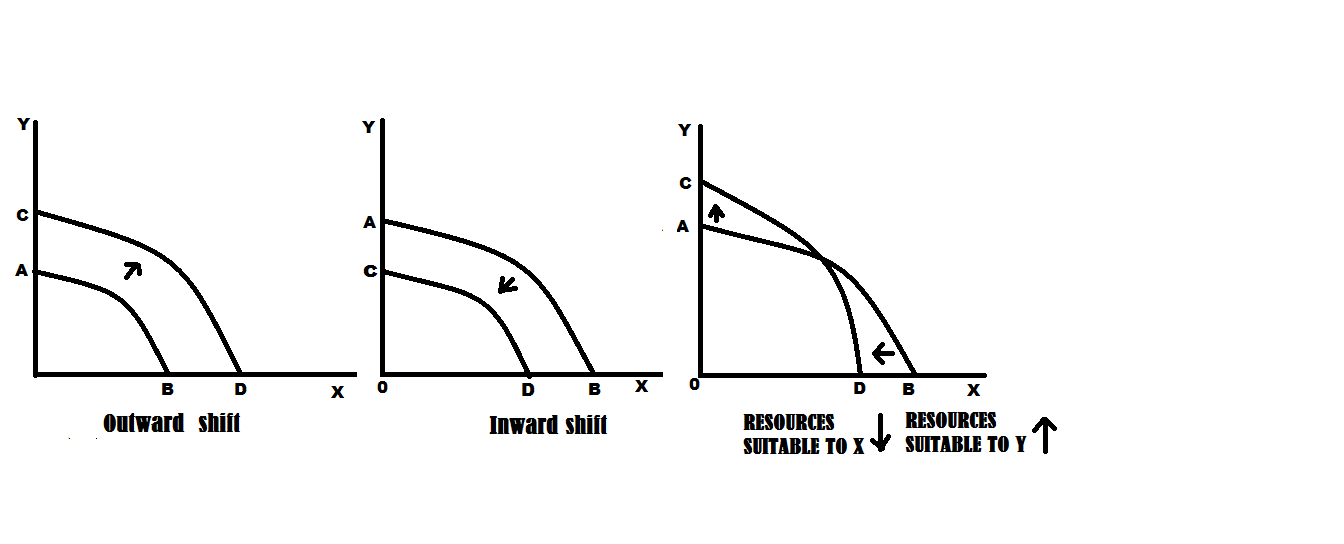
Quick Blurb:Three Types of Movement That Occur in the PPG

Three Types of Movement That Occur in the PPG (1/5)

  1. inside the PPC
  2. along the PPC
  3. shifts of the PPC
Image result for movements within the production possibility graphImage result for movements within the production possibility graphImage result for movements within the production possibility graphImage result for movements within the production possibility graph

Wednesday, January 4, 2017

Factors of Production

Factors of Production (1/4)


  • Land - natural resources
  • Labor - work exerted
  • Capital
    • Human - ppl acquire skills & knowledge
    • Physical - money, tools, buildings, equipment, machinery
  • Entrepreneurship
    • risk-taker, innovative

Trade-Offs


  • Trade-off - alternative sacrificed when decision is made, scarcity = trade-offs
  • Opportunity cost - type of trade-off, most desirable alt. given up as result of a decision
  • Guns or Butter - refers to trade-off that the gov't makes when choosing whether to produce more or less military or consumer goods.
  • Thinking at the Margins - deciding whether to +(increase) or -(decrease) 1 additional unit of some resource

The Production Possibilities Graph/Curve/Frontier (PPG,PPC,PPF) 

Image result for production possibility frontierImage result for production possibility frontier
  • graph that displays alt ways to use an economy's resources
Four Keys Assumptions abt PPG
  1. Only 2 Goods can be Produced
  2. Full Employment of Resources
  3. Fixed Resources (factors of production)
  4. Fixed Tech.
  • Efficiency - using resources in such a way as to maximize production of goods & services, increases profits
  • Underutilization - essential opposite of efficiency, using fewer resources that an economy is capable of using, decreases profits

Tuesday, January 3, 2017

Basic Concepts of Economics

Basic Concepts of Economics(1/3)

1.Macroeconomics vs. Microeconomics

  • Macroeconomics is the study of economics as a whole (inflation, debt)
  • Microeconomics is the study of individual/specific units of the economy (household & firms interactions in the market)

2.Positive vs. Normative Economics

  • Positive Economics - Descriptive economics, collects & presents facts, attempts to describe the world as is.
  • Normative Economics - Prescriptive economics, opinion-based, attempts to prescribe how the world should be.

3.Needs, or basic requirements for survival, vs. Wants, or desires

4.Scarcity vs. Shortage

  • Scarcity - Permanent, most fundamental economic problem plaguing all societies
  • Shortage - Temporary, Quantity Demanded (QD) > Quantity Supply (QS).

5.Goods vs. Services

  • Goods -Tangible commodities (bought, sold, traded, produced)
    • Capital Goods - items used in the creation of other goods
    • Consumer Goods - intended for final use by consumer
  • Services - Work performed for someone
Image result for economy